Morning! 😃 ☕️
Yesterday you met the phrase.
Today the last piece is gone.
It's a small one - but it's the piece that makes the whole thing polite. Your brain has to reach for it now.
That reaching - recalling a word instead of re-reading it - is exactly what moves a phrase from "seen it" to "own it."
In today's email...
-
📱 Day 2: First blank - fill it in before you scroll
-
🌟 The little ending that turns Korean words into respect
-
⚠️ The three ways to say hello in Korean - and who each one is for
-
🏃♂️ Why one syllable changes who you're allowed to say this to
MEMORIZE 🧠
좋은 아침 _____.
(joeun achim _____)
As always, the answer key and audio are at the bottom of this email.
CULTURAL MOMENT 🌶️
💭 The piece that disappeared today is small on the page but huge in Korean life. That ending - 이에요 (ieyo) - is what makes the phrase polite.
Korean has built-in politeness. It's not just about which words you choose; it's about the endings you attach to them. This system is called 존댓말 (jondaenmal) - polite, respectful speech - and its friendly, everyday signature is the little 요 (yo) sound at the end of a sentence. Drop 요, and the same words become 반말 (banmal), casual speech you'd only use with close friends, kids, or people much younger than you.
So 좋은 아침이에요 (joeun achimieyo), with the 요, is the warm, respectful "good morning" you can safely say to almost anyone - a coworker, a shopkeeper, someone you just met. Say 좋은 아침 (joeun achim) without the ending to your boss and it lands as too casual, even a little rude. Same three words. Completely different social message.
This is one of the first things that separates someone who studied Korean from someone who can actually use it. Native speakers hear that 요 instantly. When you keep it, you're showing respect without even thinking about it - which is exactly how Koreans experience their own language. Politeness isn't an add-on. It's stitched into the grammar.
WORD SPOTLIGHT 🔍️
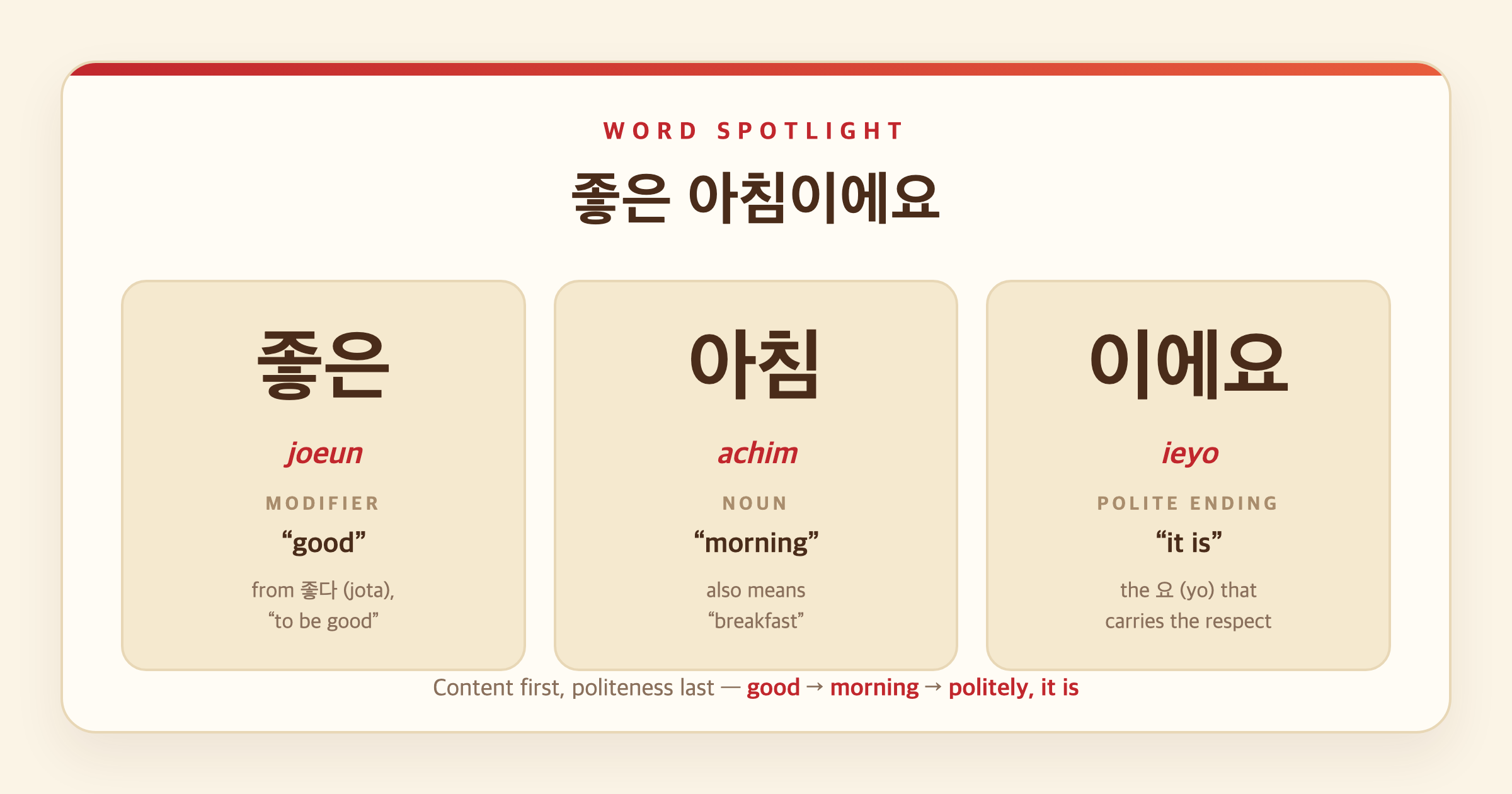
Today's disappeared word: 이에요 (ieyo)
This is the polite way to say "is" / "it is" - the Korean copula. It attaches to the end of a noun to make a gentle, respectful statement. 좋은 아침이에요 = "it is a good morning."
A quick, useful rule: you use 이에요 (ieyo) after a word that ends in a consonant (like 아침, which ends in ㅁ), and 예요 (yeyo) after a word that ends in a vowel. 학생이에요 (haksaeng-ieyo), "I'm a student." 저예요 (jeoyeyo), "it's me." You'll use this ending constantly - it's how you say what something is, politely.
Notice the magic in it: the 요 on the end is doing the respect work. Keep the ending, and every sentence you build carries that quiet courtesy Koreans expect. Lose it, and you've switched to talking to a close friend. One syllable, a whole social register.
SAY IT LIKE A LOCAL 🗣️
이에요 is three blocks — 이 · 에 · 요 — and every one of them is a plain, open vowel sound: i · e · yo. No tricky consonants, nothing to swallow.
The part learners fumble is the join. Remember yesterday's rule: 아침 ends in the 받침 (batchim) ㅁ, and a batchim slides forward onto a following vowel. So you never actually say the seam:
written:  아침 + 이에요
spoken:   아 · 치 · 미 · 에 · 요
           a    chi   mi    e    yo
Say "achim ieyo" with a gap and you sound like you're reading. Say achimieyo in one breath and you sound like you're greeting someone.
One more piece of ear-training: 이에요 is soft. In real speech it stays light and a touch quick at the end — the sentence sort of settles rather than lands. Korean statements typically fall gently in pitch at the close, so let that final 요 relax downward. Punching it ("i-e-YO!") reads as either theatrical or annoyed.
COMMON MISTAKE ⚠️
Getting the politeness level wrong. This is the mistake in Korean that actually costs you — bigger than any vocabulary gap, bigger than a wobbly accent. Korean makes you choose a speech level in every single sentence, and there is no neutral option.
The greeting 안녕 comes in three, and they are not interchangeable:
안녕하십니까   annyeonghasimnikka   FORMAL
   news broadcasts, army, ceremonies, formal business greetings

안녕하세요     annyeonghaseyo       POLITE  ← your default
   strangers, coworkers, shopkeepers, elders, anyone new

안녕           annyeong             CASUAL (반말)
   close friends, kids, people clearly younger than you
The same ladder is what's happening in your phrase. 좋은 아침이에요 is on the polite rung. 좋은 아침 — same words, ending removed — drops to the casual rung.
Two rules that will keep you out of trouble:
- When in doubt, go up. Being slightly too polite in Korean is invisible. Being too casual is loud, and the person hearing it can't un-hear it.
- Don't promote yourself to 반말. Between two people, the closer/older/senior one decides when casual speech is okay. Waiting to be invited is normal and expected, not stiff.
IN THE WILD 👂
Listen for the 요. Once you know it's there, you'll start catching it everywhere — at a convenience-store counter, in a K-drama argument where someone pointedly drops it mid-fight, in a coworker's message to the team chat versus the one they send their best friend thirty seconds later. Same person, same language, two different social settings, and the tell is one syllable at the end of the sentence.
USE IT TODAY ✍️
- Say both versions out loud, back to back — 좋은 아침 / 좋은 아침이에요 — and feel the difference in weight. That contrast is the lesson.
- Build one new 이에요 sentence. Take any consonant-ending noun you know and stick it on: 학생이에요 (haksaeng-ieyo), "I'm a student." You just used Korean grammar, not just a phrase.
- Pick your person. Think of one real person you'd greet with the polite version and one you'd greet with the casual version. Choosing correctly is the actual skill.
HEAR THE KOREAN 🎧
[OWNER: native audio file — same recording as Day 1 (the full MEMORIZE paragraph, "좋은 아침이에요"); attach in Beehiiv before sending.]
Pro tip: Listen three times.
Once for general meaning.
Once following along with the text.
Once with your eyes closed, focusing purely on pronunciation and rhythm.
PRACTICE WITH SUNHEE 💬
Stuck on that little ending? Point it out to Sunhee (선희) and she'll explain 이에요 (ieyo) in plain English - or just chat and warm up your Korean ear. Ask her here.
ANSWER KEY ✅
좋은 아침 이에요.
(joeun achim ieyo)
"Good morning" (literally: "it's a good morning").
Today's disappeared word: 이에요 (ieyo)
See you tomorrow! — 🌶️ The Kimchi and Coffee Team
There's a better way to learn.
Sara writes letters in beginner Korean, and Sam reads each one to you.
One comes to your email every morning. Free, no card.