Morning! 😃 ☕️
This is it.
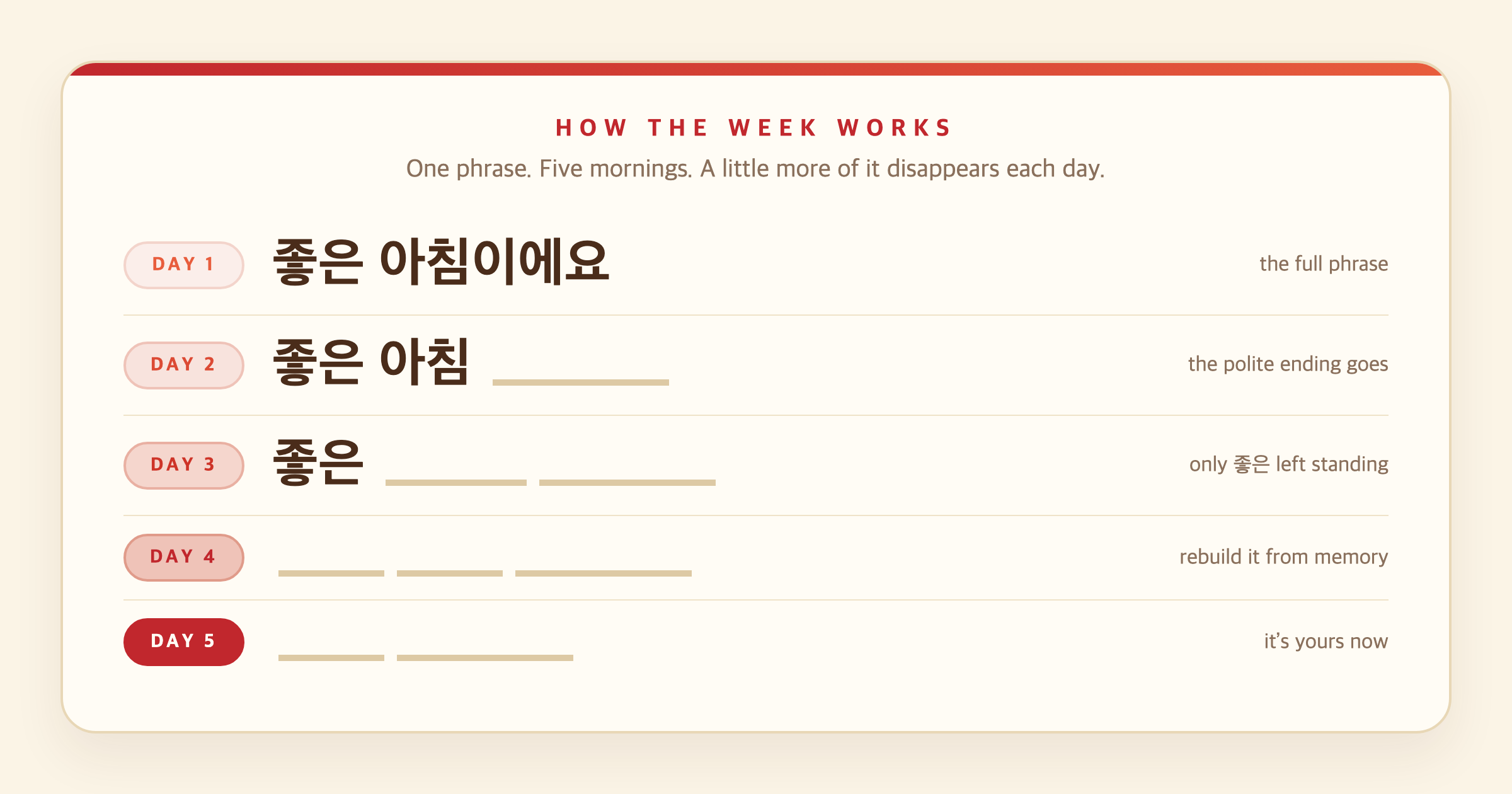
Every word is gone.
Don't scroll yet. Say it out loud - the whole phrase, from memory.
If you got it - you just did something real. Five days ago this was a foreign sound. Today it lives in your head, ready the next time you open your eyes to a good morning. That's not an app streak. That's actual Korean.
In today's email...
-
📱 Day 5: Full recall - every word is blank
-
🌟 Why this small phrase is worth more than a vocabulary list
-
⚠️ The three mistakes you now know how to avoid
-
🏃♂️ How to use it this weekend, for real
MEMORIZE 🧠
___ _______.
(______ _________)
As always, the answer key and audio are at the bottom of this email.
CULTURAL MOMENT 🌶️
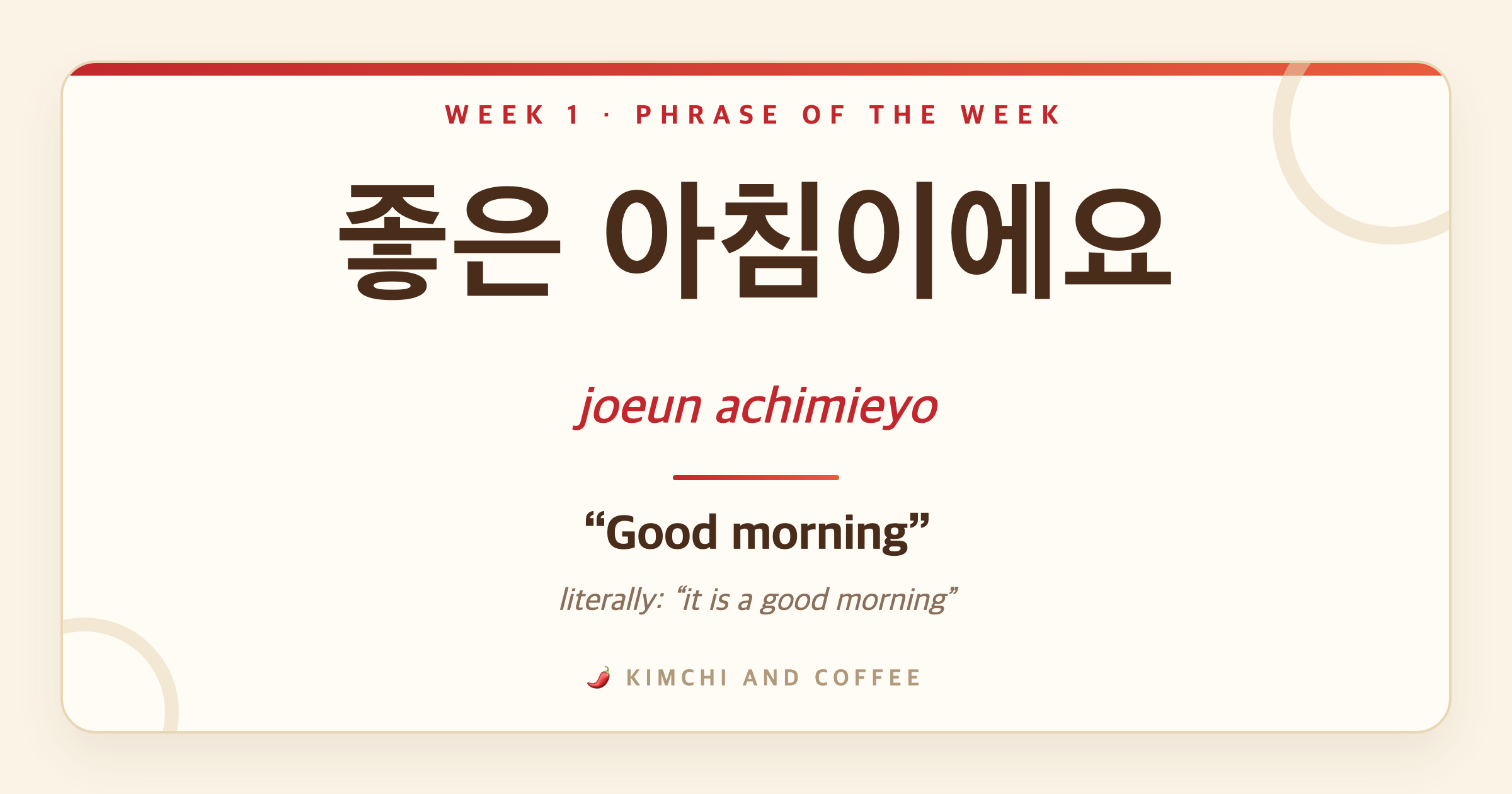
Here's why a phrase like 좋은 아침이에요 (joeun achimieyo) is worth more than a page of vocabulary: it's alive.
You didn't memorize a word list this week. You didn't earn points on an app. You sat with one real phrase - the kind a real person says to another real person at the start of a real day - and you let it settle into memory through five small mornings of practice. That's a completely different kind of learning. It sticks because it means something. You weren't drilling sounds. You were absorbing a way of greeting the world.
And look at everything folded into these three little pieces. 좋은 (joeun) - "good," a word you can now attach to a hundred nouns. 아침 (achim) - "morning," and also "breakfast," a quiet clue about how Korean treats the start of the day. 이에요 (ieyo) - the polite ending that carries 존댓말 (jondaenmal) respect in a single syllable of warmth. You didn't learn a greeting. You learned a doorway into how Korean thinks about mornings, manners, and 정 (jeong) - the warmth built one small kindness at a time.
That's what separates cultural fluency from textbook Korean. Textbook Korean gives you the words. Fluency gives you the moment - when to say it, who to say it to, and what it means to the person hearing it. You have all three now. Next week's phrase walks through the same door: the small, everyday words Koreans use to hold a warm moment open - starting with the one you say when someone's just been kind to you.
So use it this weekend. Text a friend 좋은 아침이에요 tomorrow morning. Say it to yourself over your first cup of coffee. Find the moment - a slow morning, a warm cup - and watch how naturally it comes out.
WORD SPOTLIGHT 🔍️
A 10-second tour of everything you now own:
좋은 (joeun) - "good." Your all-purpose describing word: 좋은 하루 (joeun haru, a good day), 좋은 사람 (joeun saram, a good person).
아침 (achim) - "morning," and "breakfast" too. The heart of the phrase.
이에요 (ieyo) - the polite copula, "it is." The one syllable of 요 that wraps the whole thing in respect.
Three little pieces - 좋은, 아침, 이에요 - and every one of them is everyday, real, spoken Korean you'll reuse far beyond this greeting.
SAY IT LIKE A LOCAL 🗣️
One last pass, all of it at once. Written, your phrase is seven syllable blocks. Spoken, it's seven even beats — with the batchim sliding forward so the seam disappears:
written:  좋 은 아 침 이 에 요
spoken:   조 은 아 치 미 에 요
          jo eun a  chi mi e  yo
The four things that make it sound Korean rather than translated:
- The ㅎ in 좋 stays quiet before a vowel → jo-eun, never "joh-hun."
- The ㅁ of 침 hops onto 이 → achimieyo as one word, not three.
- ㅊ takes real air — a puffed ch, not a soft j.
- Even beats, no stress. Korean is syllable-timed. Give all seven blocks the same weight and let the final 요 settle gently downward.
Say it once more, slowly, with all four in place. Then say it at normal speed. That gap between the two is the whole week, right there.
COMMON MISTAKE ⚠️
The three you now know how to sidestep — worth a final ten seconds each:
1. Wrong politeness level. The biggest one in Korean, by a distance. Keep the 요. 좋은 아침이에요 is the safe polite version; 좋은 아침 is casual and belongs only with close friends or people clearly younger than you. When in doubt, go up a level — over-polite is invisible, under-polite is not.
2. Wrong hour. 아침 means morning and Koreans hear it. Past noon, switch to 안녕하세요 (annyeonghaseyo), or send someone off with 좋은 하루 되세요 (joeun haru doeseyo).
3. Wrong form of "good." 좋은 goes in front of a noun. 좋다 / 좋아요 stands alone as a whole statement. 좋은 아침 ✅ — 좋다 아침 ❌.
Nail those three and you're already past where most casual learners stall.
IN THE WILD 👂
The real test isn't a quiz — it's the split second on a Monday when someone greets you first and you have to answer without translating. That moment is closer than you think, because you didn't learn this phrase as trivia. You learned its sound, its politeness level, its hour of the day, and the feeling it carries. That's the difference between knowing a phrase and being able to use one.
USE IT TODAY ✍️
Your weekend challenge — do at least two:
- Send it for real. Text 좋은 아침이에요 to one actual human tomorrow morning. Not practice. An actual message.
- Say it before you look at your phone. Out loud, to yourself, first thing. Your phrase, your morning, no screen involved.
- Teach it to someone. Explain the three pieces to a friend — good / morning / politely, it is. Explaining is the most brutally honest recall test there is, and it's how you find out you actually own this.
HEAR THE KOREAN 🎧
[OWNER: native audio file — same recording as Day 1 (the full MEMORIZE paragraph, "좋은 아침이에요"); attach in Beehiiv before sending.]
Pro tip: Today, flip the order. Listen with your eyes closed FIRST - then check the text. You'll be surprised how much your ear already knows.
PRACTICE WITH SUNHEE 💬
One last morning: say the whole phrase to Sunhee (선희) out loud, from memory - no peeking - and let her celebrate your first week of real Korean. Say it to Sunhee.
ANSWER KEY ✅
좋은 아침이에요.
(joeun achimieyo)
"Good morning" (literally: "it's a good morning").
Today's disappeared words: all of them - and you found them anyway.
A new Korean phrase arrives Monday morning - the two warm words you reach for the moment someone does something kind. Rest your ear this weekend - you've earned the coffee. ☕
See you Monday! — 🌶️ The Kimchi and Coffee Team
There's a better way to learn.
Sara writes letters in beginner Korean, and Sam reads each one to you.
One comes to your email every morning. Free, no card.