Morning! 😃 ☕️
Every word is gone today.
Nothing left on the page but blanks.
Before you scroll - say the full phrase out loud from memory.
Don't check. Just try. If you can rebuild it today, tomorrow will feel easy.
In today's email...
-
📱 Day 4: Full blanks - you're almost at complete recall
-
🌟 What a Korean morning greeting really carries - the idea of 정 (jeong)
-
⚠️ The 좋다 / 좋은 mix-up - and the one-second rule that fixes it
-
🏃♂️ Why a simple "good morning" builds something bigger than manners
MEMORIZE 🧠
___ __ _____.
(_____ ____ _____)
As always, the answer key and audio are at the bottom of this email.
CULTURAL MOMENT 🌶️
When a Korean says 좋은 아침이에요 (joeun achimieyo), they're doing more than marking the time of day. They're extending a little warmth - and Korean culture has a beautiful word for that kind of warmth: 정 (jeong).
정 is hard to translate cleanly. It's the deep, quiet attachment that grows between people who share small daily kindnesses - the affection built not through grand gestures but through steady, ordinary care. A neighbor who always greets you. A café owner who remembers your order. The coworker who says good morning every single day. That accumulation of tiny warmth is 정.
A morning greeting is one of the smallest, most repeatable ways Koreans build it. Saying 좋은 아침이에요 to the same people, morning after morning, is how a relationship quietly deepens - not because the words are special, but because you keep showing up with them. It's the opposite of a transaction. It's a thread you tie a little tighter each day.
This is why greetings matter so much in Korea, and why the polite ending you learned on Day 2 isn't stiffness - it's care. A good morning offered with respect and repeated with consistency is how strangers slowly become your people. Four days into this phrase, you're not just memorizing sounds. You're learning a small, daily act of connection.
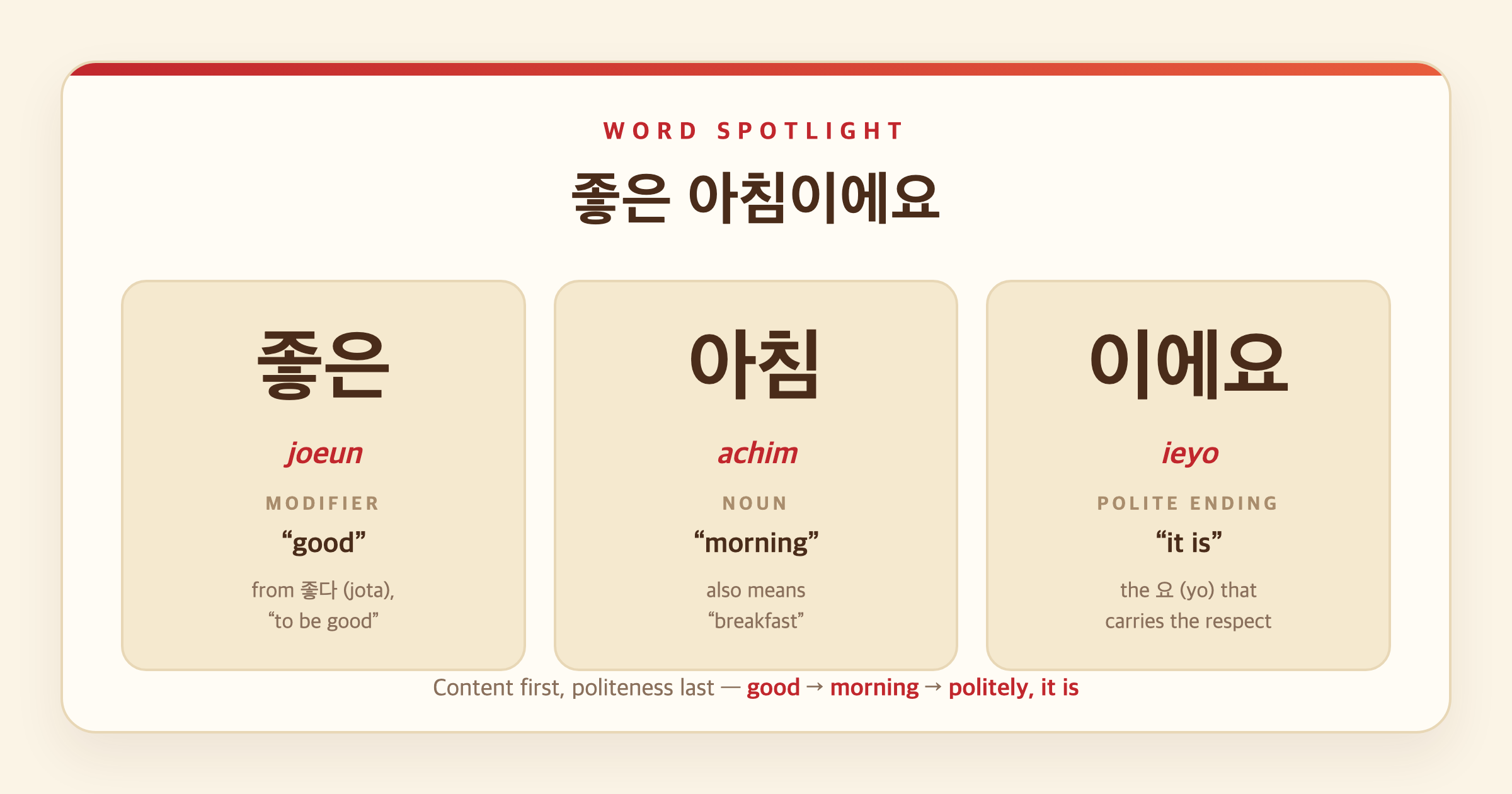
WORD SPOTLIGHT 🔍️
Today's disappeared word to revisit: 좋은 (joeun)
You met it on Day 1. But now that the whole phrase is blank, it's worth one more look - because 좋은 is a word you'll reuse constantly, far beyond this greeting.
좋은 (joeun) is the describing form of 좋다 (jota), "to be good." Stick 좋은 in front of a noun and you've made it "good": 좋은 하루 (joeun haru), "a good day"; 좋은 사람 (joeun saram), "a good person"; 좋은 생각 (joeun saenggak), "a good idea."
That's why this phrase is such a smart first step. Learn 좋은 아침이에요 and you've quietly picked up a pattern you can swing in a dozen directions. In fact, one of the warmest things you can say as you part ways in the morning is 좋은 하루 되세요 (joeun haru doeseyo) - "have a good day." Same 좋은 you already know, doing brand-new work.
One little word, and the language starts opening up around it.
SAY IT LIKE A LOCAL 🗣️
Here's a satisfying one, because it explains a sound you'd never guess from the spelling.
좋다 is written 좋 + 다 — jo, then da. But nobody says "jo-da." That ㅎ at the bottom of 좋 crashes into the ㄷ of 다 and the two fuse into an aspirated ㅌ (t with a puff). So:
written:  좋 + 다
spoken:   조 · 타     →  jota
That's why the romanization is jota, not "johda." Same ㅎ, different neighbor, different result — and this is a general Korean rule, not a one-off: ㅎ meeting ㄱ, ㄷ, ㅂ, or ㅈ turns them into their aspirated partners (ㅋ, ㅌ, ㅍ, ㅊ).
Now compare all three shapes of the same word:
좋다     jota     "to be good"       ← dictionary form, ㅎ fuses into ㅌ
좋은     joeun    "good (+ noun)"    ← ㅎ goes quiet before a vowel
좋아요   joayo    "it's good / I like it"  ← ㅎ goes quiet again
One letter, three behaviours, all predictable. You're not memorizing exceptions here — you're learning the rules Korean actually runs on.
COMMON MISTAKE ⚠️
Putting 좋다 in front of the noun.
It's a natural slip: you learn 좋다 = "good," so you reach for 좋다 아침. Korean won't have it. 좋다 is a full statement all by itself — it means "it is good," a complete sentence. To attach the idea to a noun, you must switch to the describing form, 좋은.
✅  좋은 아침     joeun achim     "a good morning"
❌  좋다 아침
✅  아침이 좋아요  achimi joayo    "the morning is good"
The one-second rule: if a noun follows, it's 좋은. If the sentence stops there, it's 좋아요 (polite) or 좋다 (plain).
Same trap waits for you with every Korean descriptive verb, so learning it now on 좋다 saves you a hundred future stumbles.
IN THE WILD 👂
정 (jeong) isn't a word you'll hear people announce — it's the reason for things you'll notice. The shop owner who hands you an extra side dish. The coworker who quietly makes your coffee too. The fact that the same person greets you every morning for two years and it never once feels like a formality. When Koreans say a relationship has 정 in it, that's what they're pointing at: warmth that accumulated instead of arriving.
USE IT TODAY ✍️
- Recite the whole phrase cold, three times, without looking at the answer key. Getting it wrong and correcting yourself locks it in harder than reading it right.
- Build three 좋은 phrases. 좋은 하루 / 좋은 사람 / 좋은 생각. Say them out loud. That's a grammar pattern, not vocabulary.
- Practice the fusion. Say 좋다 as jota ten times until "joh-da" stops feeling like an option.
HEAR THE KOREAN 🎧
[OWNER: native audio file — same recording as Day 1 (the full MEMORIZE paragraph, "좋은 아침이에요"); attach in Beehiiv before sending.]
Pro tip: Listen three times.
Once for general meaning.
Once following along with the text.
Once with your eyes closed, focusing purely on pronunciation and rhythm.
PRACTICE WITH SUNHEE 💬
Ready to stretch? Say 좋은 아침이에요 (joeun achimieyo) to Sunhee (선희) without peeking at the text - let it come from memory, and she'll catch you if a piece slips. Try it with her.
ANSWER KEY ✅
좋은 아침이에요.
(joeun achimieyo)
"Good morning" (literally: "it's a good morning").
Today's disappeared words: 좋은, 아침, 이에요 - all of them.
See you tomorrow! — 🌶️ The Kimchi and Coffee Team
There's a better way to learn.
Sara writes letters in beginner Korean, and Sam reads each one to you.
One comes to your email every morning. Free, no card.