Morning! 😃 ☕️
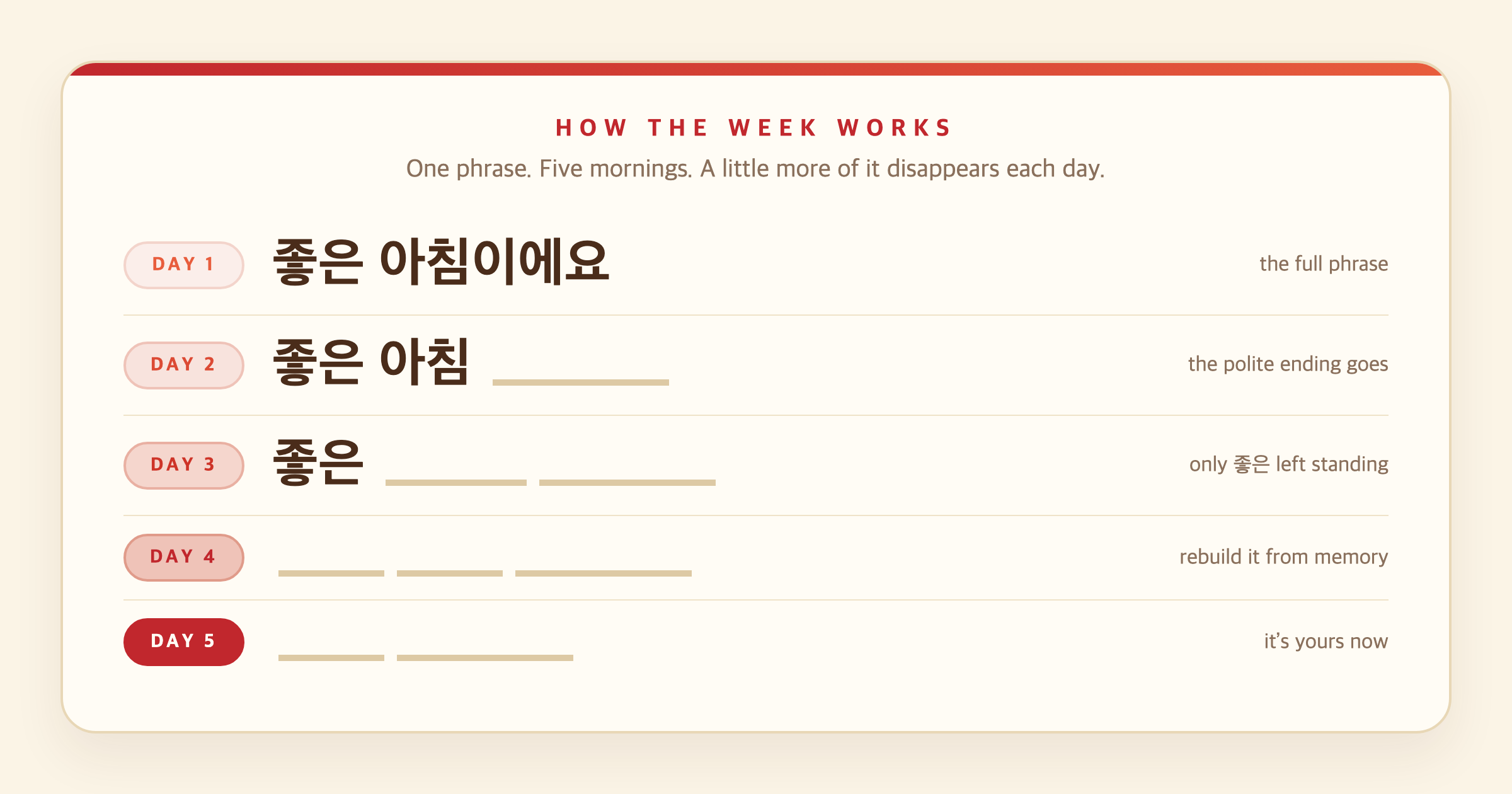
Two pieces gone today.
Only the first word - 좋은 (joeun) - is still standing.
Can you still find the rest?
Close your eyes for three seconds before you scroll to the phrase. Try to see it in your head first.
That little effort - the reaching - is where fluency lives.
In today's email...
-
📱 Day 3: Two blanks - the phrase is starting to disappear
-
🌟 The morning ritual most learners never think about - Korean café culture
-
⚠️ The timing mistake that makes a perfect phrase land wrong
-
🏃♂️ How to drop this phrase at exactly the right moment
MEMORIZE 🧠
좋은 ____ _____.
(joeun ____ _____)
As always, the answer key and audio are at the bottom of this email.
CULTURAL MOMENT 🌶️
If there's one country that would build an entire morning ritual around a phrase like this, it's Korea. Coffee here isn't a side habit - it's woven into daily life. Korea has one of the highest densities of cafés in the world, and a 카페 (kape) on nearly every corner is where mornings, meetings, and whole friendships happen.
Ordering a 커피 (keopi) before work, meeting a friend at a café mid-morning, texting good-morning over a shared coffee photo - these are real, everyday Korean rhythms. And a warm 좋은 아침이에요 (joeun achimieyo) fits all of them. It's the kind of greeting you send with a café selfie, or say to the coworker already in line for the morning coffee run.
Here's the cultural nuance, though: timing. 좋은 아침이에요 is genuinely a morning phrase - Koreans feel the "아침" (morning) in it. Use it at 9am and it's perfect. Use it at 3pm and it lands like calling someone at dinner to say "good morning" - a little off. For any other time of day, that's when the all-purpose 안녕하세요 (annyeonghaseyo) takes over.
That sensitivity to when a phrase belongs is exactly what separates textbook Korean from lived Korean. You're not just learning the words. You're learning the moment they're meant for - a slow morning, a warm cup, and someone you want to greet with a little extra care.
WORD SPOTLIGHT 🔍️
Today's disappeared words: 아침 (achim) and 이에요 (ieyo)
You've now met both of these. Today, with only 좋은 left on the page, they're worth one more look together - because side by side they show you how a Korean sentence is built: content first, politeness last.
아침 (achim) is the "what" - the morning itself (and, as you learned, breakfast too). It's the heart of the phrase, the image you're actually pointing at.
이에요 (ieyo) is the "how" - the polite ending that wraps the whole thing in respect. It doesn't add new meaning; it adds manners.
Korean almost always works in this order: the real thing you're saying, then the ending that sets the tone. 좋은 (joeun, good) → 아침 (achim, morning) → 이에요 (ieyo, politely, it is). Once you feel that shape, you stop translating word by word and start hearing whole phrases - which is exactly what's happening to you right now, three days in.
SAY IT LIKE A LOCAL 🗣️
Today, zoom in on 아침 — the block most learners flatten.
아  =  ㅇ + ㅏ   →  "a"  (as in "father")
침  =  ㅊ + ㅣ + ㅁ  →  "chim"
Two things to notice.
That ㅇ at the front is silent. In 아, the little circle is a placeholder — Korean syllable blocks must start with a consonant slot, so when a syllable begins with a vowel sound, ㅇ holds the door. It only becomes a real sound (an "ng") when it sits at the bottom of a block as a batchim. This one fact unlocks a huge amount of Hangul reading.
ㅊ is aspirated. It's a ch pushed out with a real puff of air — hold your palm near your mouth and you should feel it. Korean distinguishes ㅈ (plain j), ㅉ (tense jj), and ㅊ (aspirated ch), and they are genuinely different letters, not accents. 침 uses the airy one.
And that ㅁ at the bottom of 침 is your batchim from Day 1 — the one that leaps onto 이에요 and gives you achimieyo.
Read the whole thing straight through one more time: jo-eun a-chi-mi-e-yo. Seven even beats. You're not sounding it out anymore, are you?
COMMON MISTAKE ⚠️
Using it at the wrong hour.
좋은 아침이에요 has the word "morning" sitting right in the middle of it. Korean speakers hear that. Say it at 2pm and it reads as a joke, a mistake, or a comment on how late your friend woke up.
The fix is simple and it makes you sound sharper immediately:
- Morning → 좋은 아침이에요 (joeun achimieyo), or the always-safe 안녕하세요 (annyeonghaseyo)
- Any other time of day → 안녕하세요 (annyeonghaseyo)
- Leaving someone during the day → 좋은 하루 되세요 (joeun haru doeseyo), "have a good day"
Second, smaller trap: don't reach for the Konglish 굿모닝 (gutmoning) as your default. It exists, Koreans use it playfully in texts and captions, and it's fun — but it's a wink, not a greeting. It won't do the work that 좋은 아침이에요 does.
IN THE WILD 👂
The most Korean version of this whole lesson is a café at 8:40am: someone orders a 커피 (keopi), greets the barista, then walks into an office and greets the room. Same person, same five minutes, and the greeting shifts with the audience. Notice that the phrase isn't performing — it's just what people say when they arrive somewhere, on purpose, at the start of a day.
USE IT TODAY ✍️
- Say 아침 five times with real air on the ㅊ. Palm in front of your mouth. If you don't feel the puff, you're saying ㅈ.
- Order something. Next coffee you buy, say 좋은 아침이에요 in your head as you walk up — timed to the actual morning. Rehearsing in the real moment is worth ten flashcards.
- Bank the bonus phrase. Say 좋은 하루 되세요 (joeun haru doeseyo) three times. It's the goodbye twin of your greeting, and you already know half of it.
HEAR THE KOREAN 🎧
[OWNER: native audio file — same recording as Day 1 (the full MEMORIZE paragraph, "좋은 아침이에요"); attach in Beehiiv before sending.]
Pro tip: Listen three times.
Once for general meaning.
Once following along with the text.
Once with your eyes closed, focusing purely on pronunciation and rhythm.
PRACTICE WITH SUNHEE 💬
Halfway through the week is the perfect moment to say it out loud. Greet Sunhee (선희) with 좋은 아침이에요 (joeun achimieyo) - she'll answer you right back and nudge you gently where it wobbles. Practice with Sunhee.
ANSWER KEY ✅
좋은 아침 이에요.
(joeun achim ieyo)
"Good morning" (literally: "it's a good morning").
Today's disappeared words: 아침 (achim), 이에요 (ieyo)
See you tomorrow! — 🌶️ The Kimchi and Coffee Team
There's a better way to learn.
Sara writes letters in beginner Korean, and Sam reads each one to you.
One comes to your email every morning. Free, no card.