Morning! 😃 ☕️
You say "good morning" a thousand times a year. Half-awake, on autopilot, usually before the coffee has done its job.
Now meet the Korean version. Same warmth, a completely different feeling.
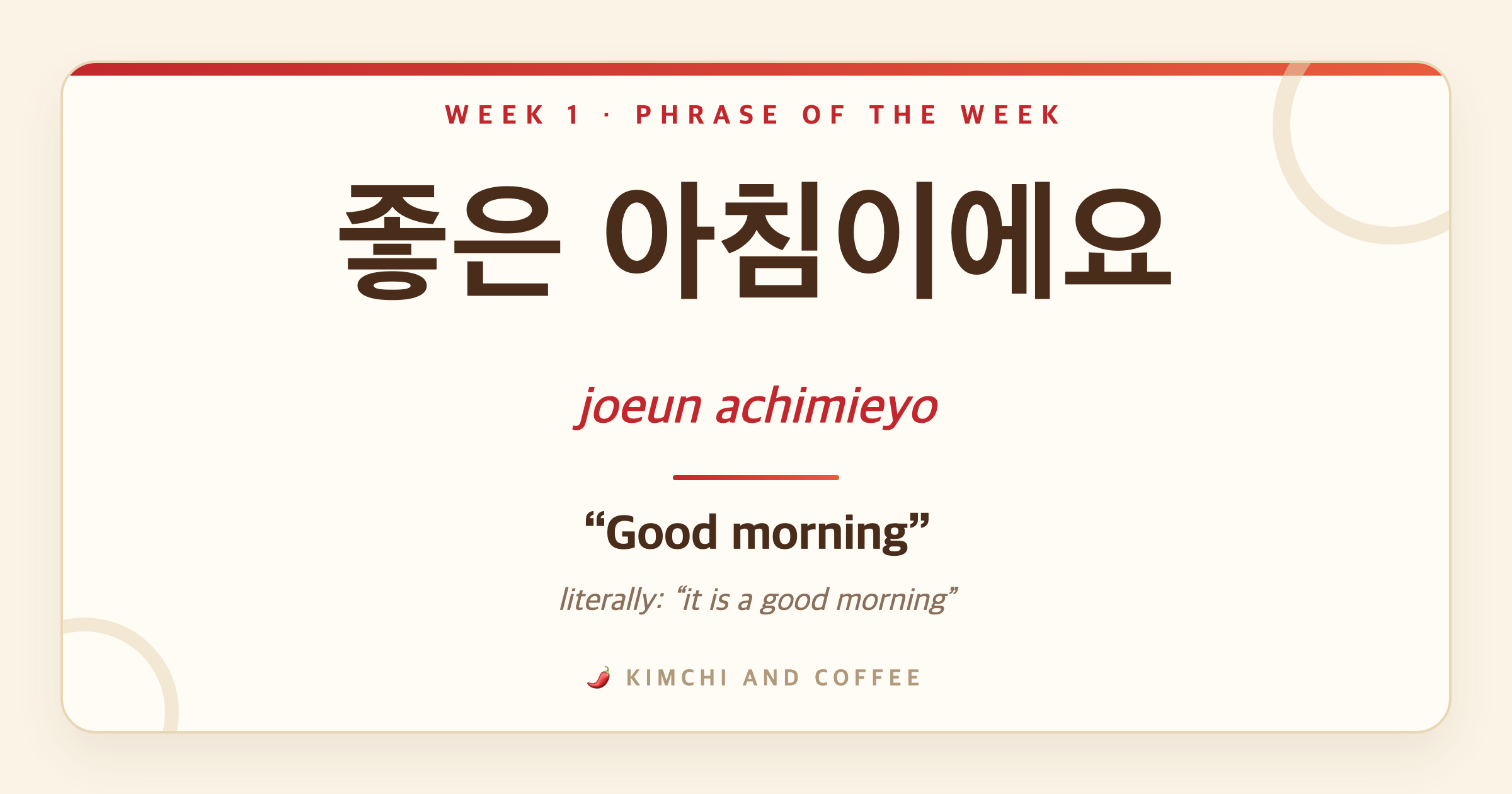
좋은 아침이에요.
(joeun achimieyo — "good morning")
In Korean this isn't a throwaway line. It literally means "it's a good morning" — you're not just greeting someone, you're naming the day as a good one out loud. Say it in a café, in a text, to a coworker at 9am, and you sound less like a tourist and more like someone who belongs.
This week, you're going to own it.
In today's email...
-
📱 Day 1: The full phrase - read it, say it, start locking it in
-
🗣️ How to actually pronounce it - the silent letter almost everyone gets wrong
-
🌟 Where Koreans actually use this - and the greeting they reach for even more
-
🏃♂️ The two little words that carry the whole thing
MEMORIZE 🧠
좋은 아침이에요.
(joeun achimieyo)
As always, the answer key and audio are at the bottom of this email.
SAY IT LIKE A LOCAL 🗣️
Here's the good news about Korean: Hangul is phonetic. Unlike English, where "though," "through," and "tough" all lie to you, a Korean syllable block tells you exactly what to say. Learn the blocks and you can read the sound.
Your phrase is seven syllable blocks:
좋   은   아   침   이   에   요
jo  eun   a  chim   i    e   yo
Now three things that turn "textbook" into "natural":
1. The ㅎ in 좋 goes quiet. That bottom letter in 좋 is ㅎ (an h sound). But when the next block starts with a vowel, that ㅎ softens away almost completely. So 좋은 is jo-eun, not "joh-hun." Two smooth beats.
2. The ㅁ slides forward. 아침 ends in the consonant ㅁ (an m) — Korean calls a final consonant like this a 받침 (batchim). When the next block starts with a vowel, the batchim hops over and starts that syllable instead. So 아침 + 이에요 comes out of a Korean mouth as a-chi-mi-e-yo, not "a-chim... i-e-yo." That's why the romanization reads achimieyo as one flowing word.
Spoken, the whole thing lands like this:
조 · 은 · 아 · 치 · 미 · 에 · 요
jo   eun   a   chi   mi   e   yo
3. Don't stress anything. English is stress-timed — we punch one syllable ("good MOR-ning") and swallow the rest. Korean is syllable-timed: every block gets roughly the same length and weight, like an even drumbeat. Say all seven beats evenly and you'll sound dramatically more Korean than someone with perfect vocabulary and English rhythm.
CULTURAL MOMENT 🌶️
Here's the first thing to know: Koreans have a greeting that works morning, noon, and night - 안녕하세요 (annyeonghaseyo). It's the all-purpose "hello," and it literally asks whether you're at peace. If you only ever learn one Korean greeting, that's the one.
So why start the week with 좋은 아침이에요 (joeun achimieyo) instead? Because this phrase does something 안녕하세요 doesn't. It's warm, specific, and unmistakably a morning greeting - the kind you send in a text at sunrise, say to coworkers as you set your bag down, or offer the barista as the espresso machine hisses to life. It carries a little extra care in it.
You'll hear and read 좋은 아침이에요 constantly in modern Korea - in workplace group chats, on café chalkboards, in the good-morning messages friends fire off before they're fully awake. It has a gentle, considerate feeling, because you're not just saying "hi." You're saying, out loud, that the morning is a good one.
That's exactly why it's your week-one phrase. It's warm, it's everyday, and the moment you use it at the right time, a Korean speaker feels it. You didn't just greet them. You wished them a good morning, on purpose.
WORD SPOTLIGHT 🔍️
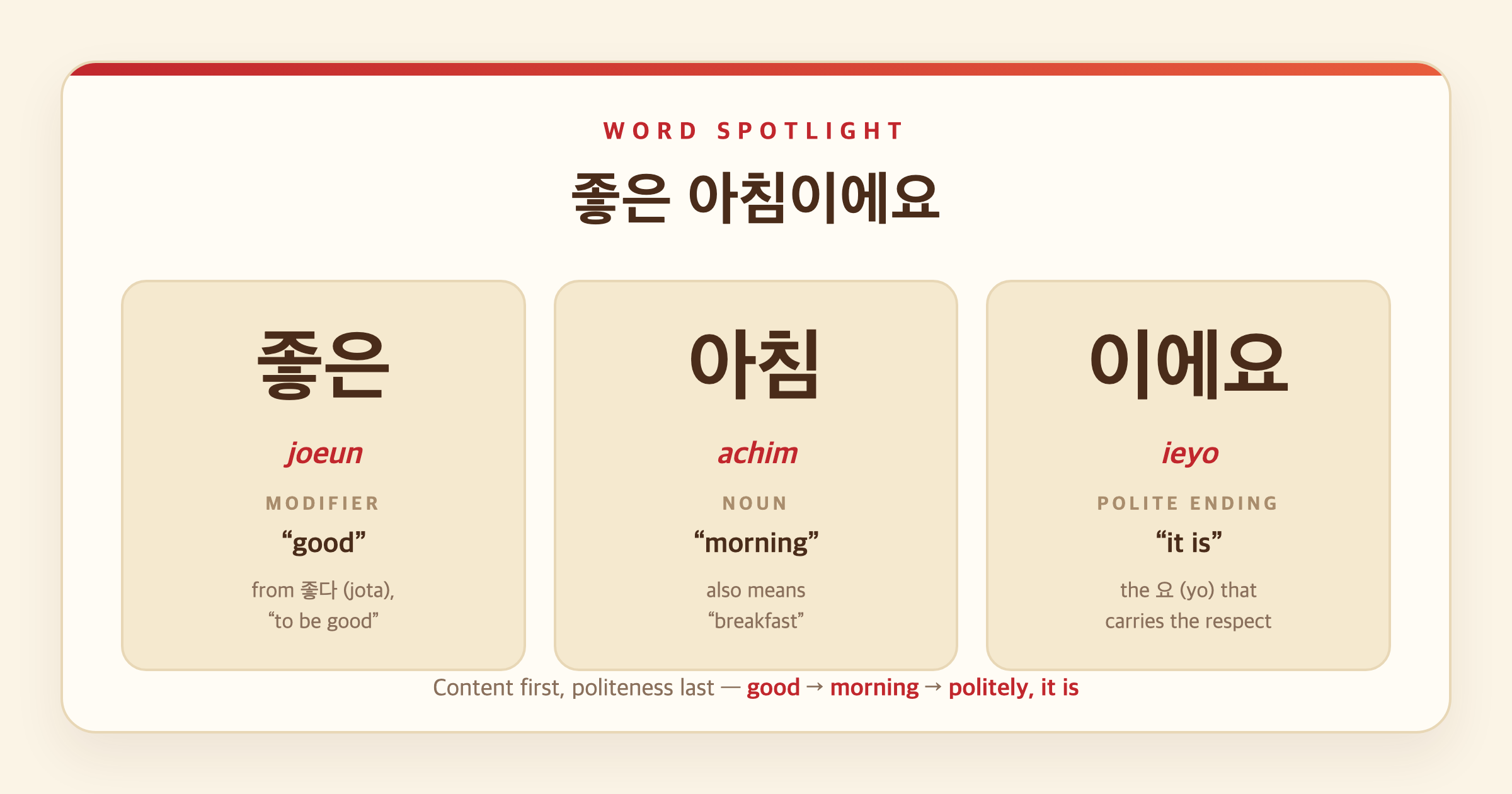
Today's focus: 좋은 (joeun) and 아침 (achim) - the two building blocks that carry the whole phrase.
좋은 (joeun) means "good." It comes from 좋다 (jota), "to be good" or "to be nice" - one of the most useful words in all of Korean. You'll meet it everywhere: 좋아요 (joayo), "I like it / it's good"; 좋은 사람 (joeun saram), "a good person." Learn 좋은 and you can start describing almost anything you like.
아침 (achim) means "morning." Here's a small gift: 아침 also means "breakfast." Same word for the time of day and the first meal in it - which tells you something quietly lovely about how Korean treats mornings, as a thing you sit down to, not just rush through. When someone asks 아침 먹었어요? (achim meogeosseoyo?) they're asking "did you eat breakfast?" - itself a common, caring way to say good morning.
Two words in, and you already own a piece of how Korean sees the start of the day.
COMMON MISTAKE ⚠️
Sounding out the ㅎ in 좋은.
Learners who have just figured out that ㅎ is "h" proudly say "joh-hun" — and it lands like a hiccup in the middle of the word. Korean doesn't want that h. Say jo-eun, gliding straight from the first block into the second.
A close cousin of the same mistake: chopping the phrase into three separate English-style words — "joeun. achim. ieyo." Korean doesn't pause there. The batchim carries forward, so the last four blocks glue together as achimieyo. One warm ribbon of sound, not three stamps.
IN THE WILD 👂
Where you'd actually run into this today: a 카톡 (katok) — a KakaoTalk message — landing at 7am from a friend who's already up. A coworker greeting the room as they hang up their coat. A café's morning post. And, if you're staying with an older Korean family, the very formal, very affectionate morning question 안녕히 주무셨어요? (annyeonghi jumusyeosseoyo?) — "did you sleep well?" — which is how you greet an elder at breakfast.
USE IT TODAY ✍️
Small reps, today, out loud. Pick two:
- Say it seven times, one beat per block — 조·은·아·치·미·에·요 — evenly, no stress. Then speed it up until it's one word.
- Text it to yourself. Seriously. Send 좋은 아침이에요 to your own phone now, so it's sitting there tomorrow morning before you're awake enough to overthink it.
- Greet your coffee. Whatever makes your first cup — machine, kettle, barista — say it to that. Ridiculous, effective, and nobody's grading you.
HEAR THE KOREAN 🎧
[OWNER: native audio file — record a native Korean speaker reading the MEMORIZE paragraph ("좋은 아침이에요") and attach it here in Beehiiv before sending.]
Pro tip: Listen three times.
Once for general meaning.
Once following along with the text.
Once with your eyes closed, focusing purely on pronunciation and rhythm.
PRACTICE WITH SUNHEE 💬
Meet Sunhee (선희) - your Korean morning companion, a warm friend who already knows this week's phrase. Stop by and say hello: meet Sunhee.
ANSWER KEY ✅
좋은 아침이에요.
(joeun achimieyo)
"Good morning" (literally: "it's a good morning").
Today's disappeared words: None - Day 1 is always the full phrase. Lock it in.
See you tomorrow! — 🌶️ The Kimchi and Coffee Team
There's a better way to learn.
Kimchi and Coffee delivers one memorable disappearing Korean phrase to your inbox daily. It’s a simple, effective way to build fluency without the frustration.